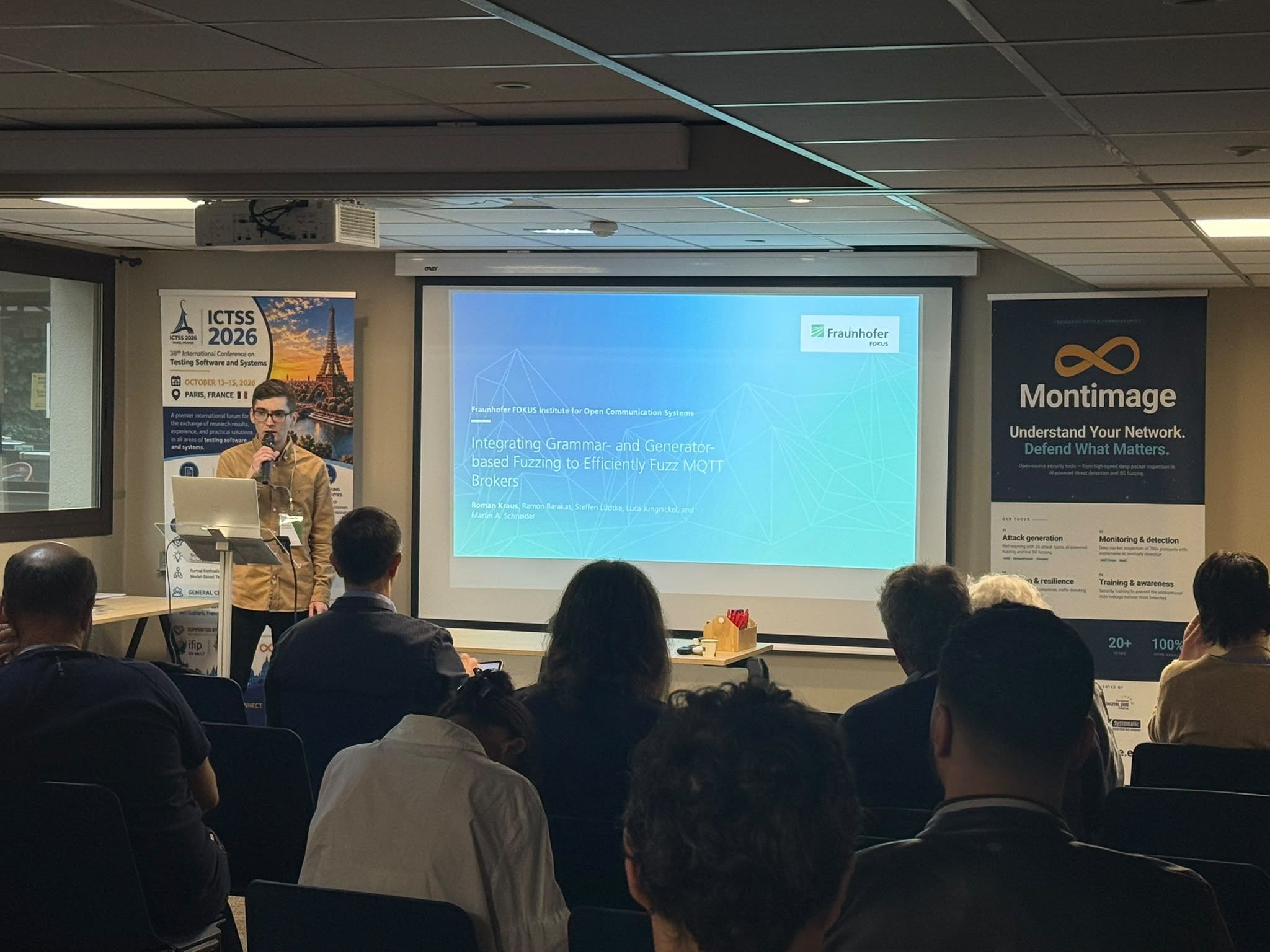
SECASSURED made a strong contribution to the 38th International Conference on Testing Software and Systems (ICTSS 2026), held in Paris, France, from 13–15 October 2026, with four scientific paper presentations and one poster. The contributions highlighted research advances in AI-assisted security testing, vulnerability detection, attack simulation, fuzzing, and adversarial robustness.
ICTSS is an international forum bringing together researchers and industry practitioners to exchange knowledge and present advances in software testing, verification, and quality assurance. This year’s conference featured a diverse programme covering artificial intelligence, large language models (LLMs), security testing, embedded systems, and formal methods.
SECASSURED Research Contributions
The four paper presentations and poster demonstrated the breadth of research undertaken by SECASSURED partners and its relevance to emerging cybersecurity challenges.
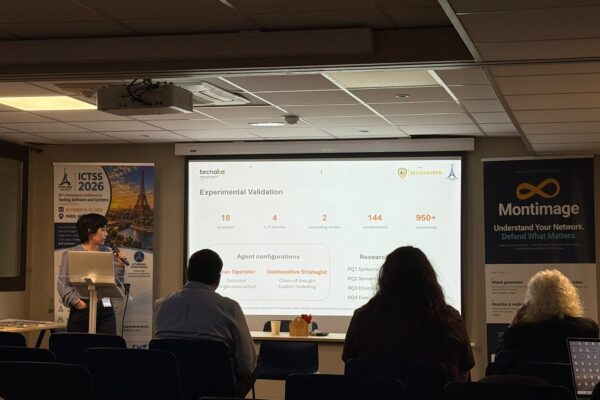
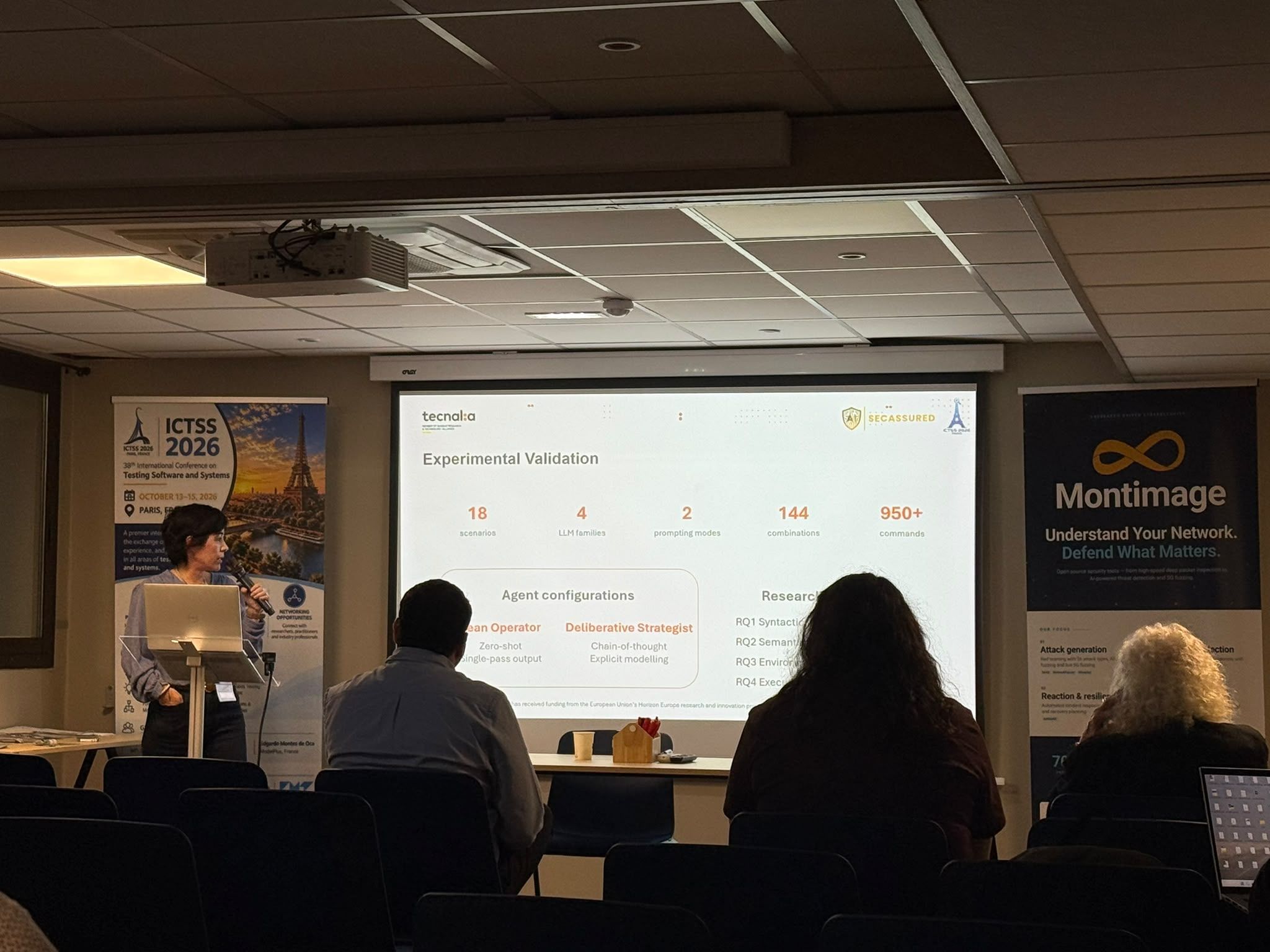
1. SecAttSIM: An Agentic Architecture for Assurance-Driven Attack Simulation and Empirical Assessment of LLM Capabilities
Eider Iturbe and Angel Rego – TECNALIA
This research introduces SecAttSIM, an agentic architecture connecting security assurance claims with controlled attack simulations. By leveraging LLMs to support attack scenario design and execution, the approach aims to generate dynamic, explainable evidence for security assurance and improve the assessment of system resilience.
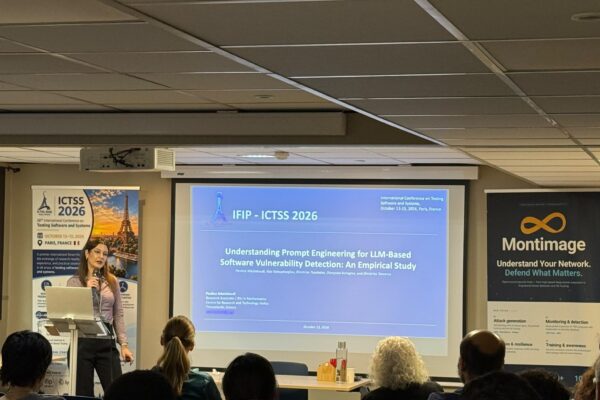
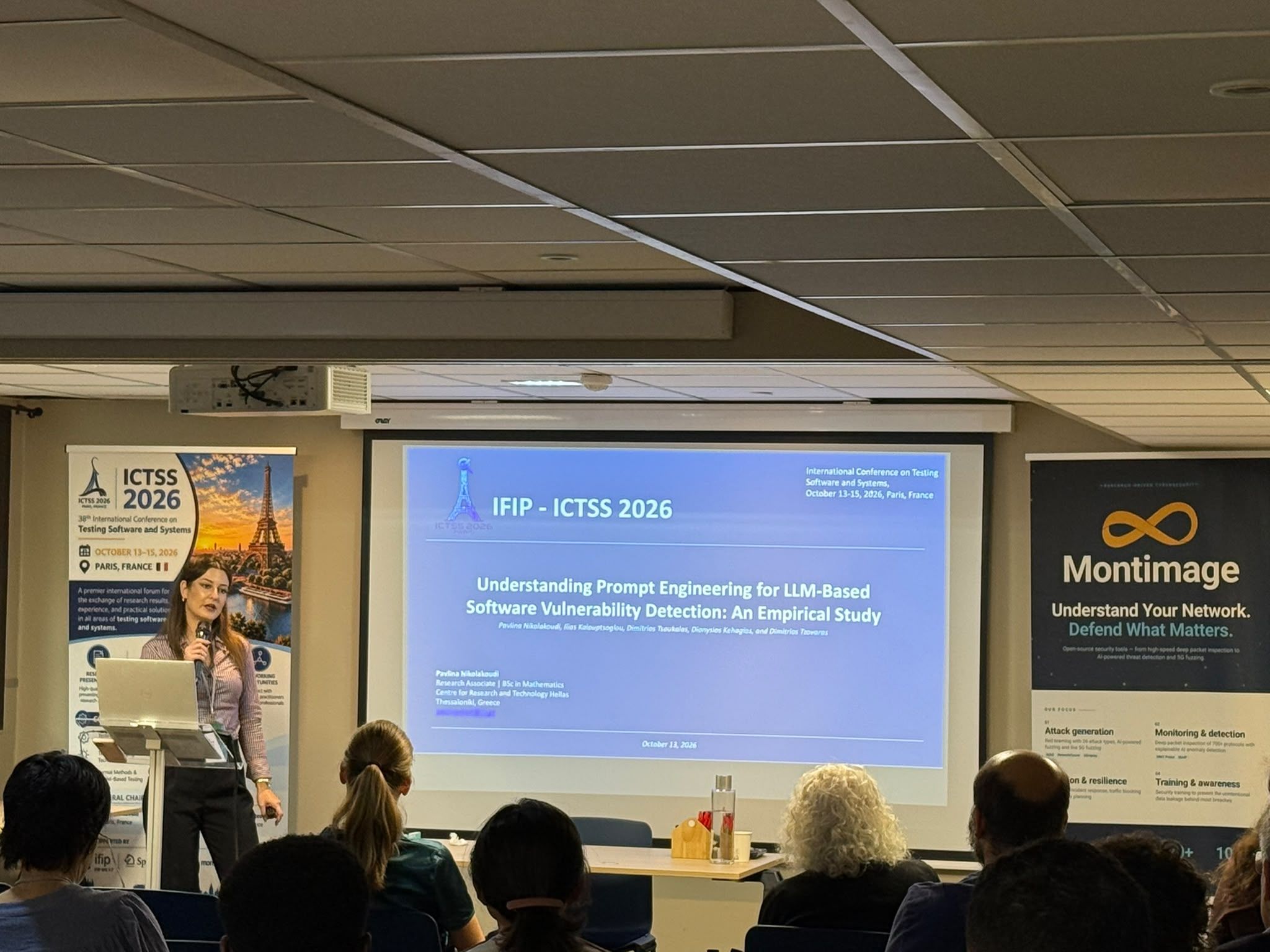
2. Understanding Prompt Engineering for LLM-Based Software Vulnerability Detection: An Empirical Study
Pavlina Nikolakoudi, Ilias Kalouptsoglou, Dimitrios Tsoukalas, Dionysios Kehagias, and Dimitrios Tzovaras – CERTH
The paper investigates how different prompt-engineering strategies influence the effectiveness of LLMs in detecting software vulnerabilities. Its findings provide valuable insights into improving AI-assisted vulnerability detection and making automated security assessment more reliable.
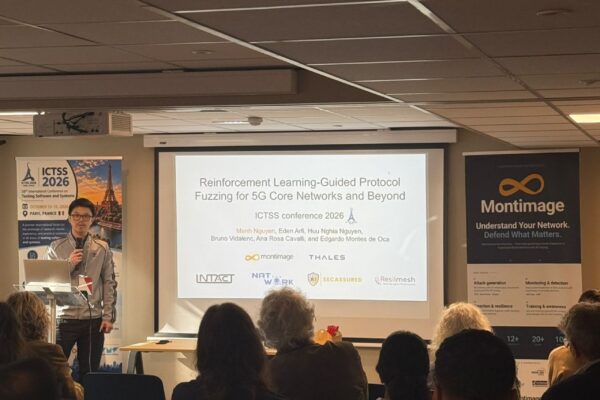
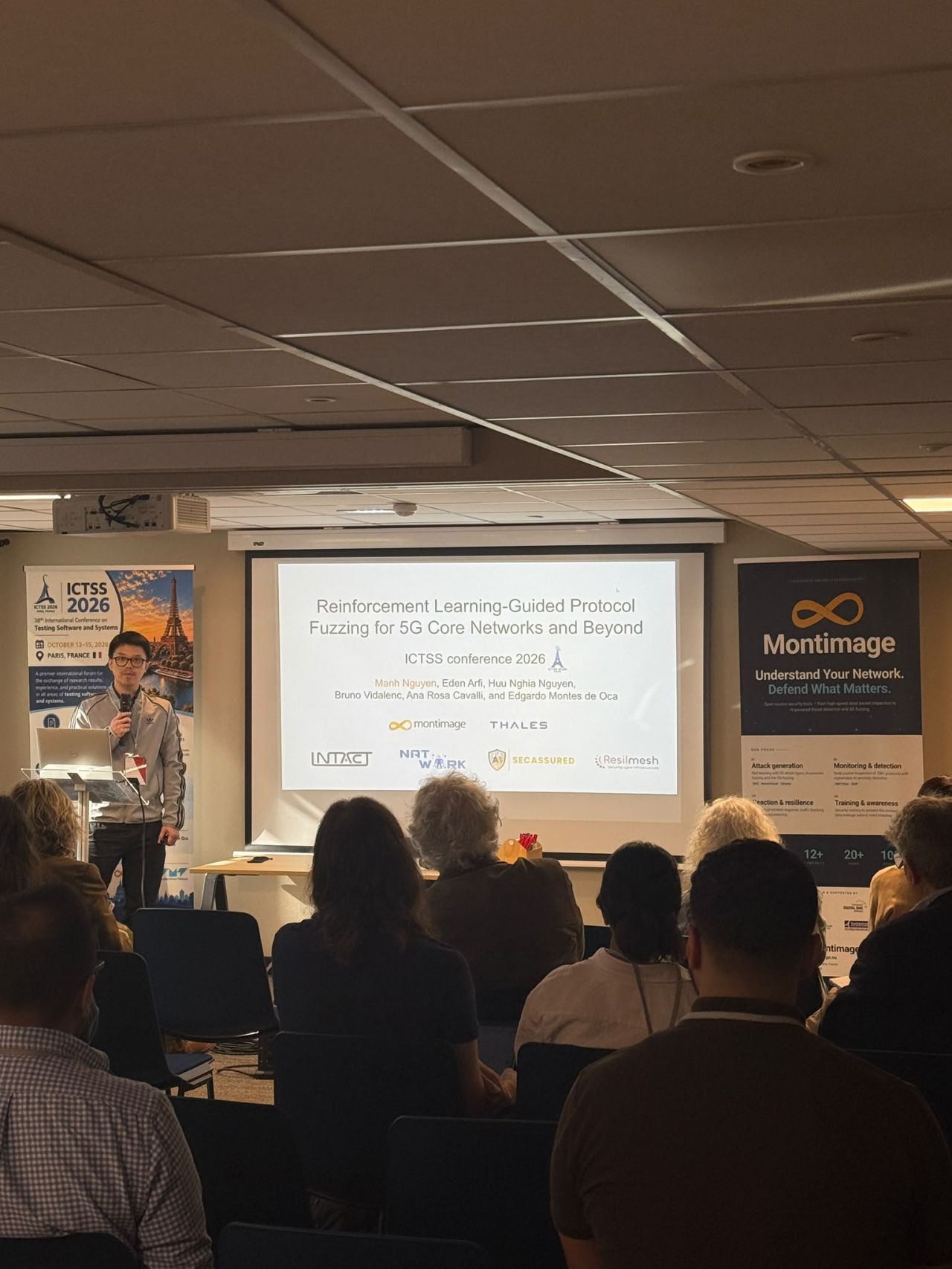
3. Reinforcement Learning-Guided Protocol Fuzzing for 5G Core Networks and Beyond
Presented by Manh-Dung Nguyen – Montimage
This work presents an adaptive security testing approach that combines reinforcement learning with protocol fuzzing to identify vulnerabilities in complex 5G networks. By adapting test generation based on runtime feedback, the approach helps improve the efficiency and effectiveness of protocol security testing.
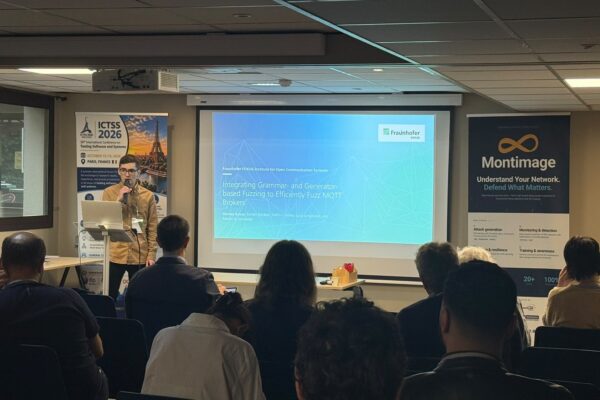
4. Integrating Grammar- and Generator-based Fuzzing to Efficiently Fuzz MQTT Brokers
Roman Kraus, Ramon Barakat, Steffen Lüdtke, Luca Jungnickel, and Martin Schneider – Fraunhofer FOKUS
The paper introduces a novel fuzzing approach combining grammar-based and generator-based input generation to improve the security testing of MQTT brokers. Evaluation on three MQTT broker implementations identified ten vulnerabilities, demonstrating the practical effectiveness of the method in detecting security weaknesses in IoT communication infrastructure.
Poster: Measuring Adversarial Subspaces in Deep Neural Networks for Robustness Assessment
Marvin Vogt and Martin Schneider
The poster addressed the assessment of adversarial robustness in deep neural networks, an important challenge for the development and security assurance of trustworthy AI systems.
Advancing Security Assurance Through Research Collaboration
SECASSURED’s participation at ICTSS 2026 provided an excellent opportunity to share project-related research with the international software testing community, exchange ideas, and explore emerging approaches to automated security assessment.
Together, the contributions reflect the project’s ambition to advance intelligent, evidence-driven security engineering by combining AI-assisted testing, vulnerability analysis, attack simulation, and robustness assessment.
We thank the ICTSS 2026 organising committee, programme committee, session chairs, and everyone involved in making the conference such a successful and engaging event. Special thanks to the organisers for creating an excellent environment for scientific exchange, valuable discussions, and new connections within the international research community.
We look forward to continuing these exchanges and contributing to future editions of ICTSS!